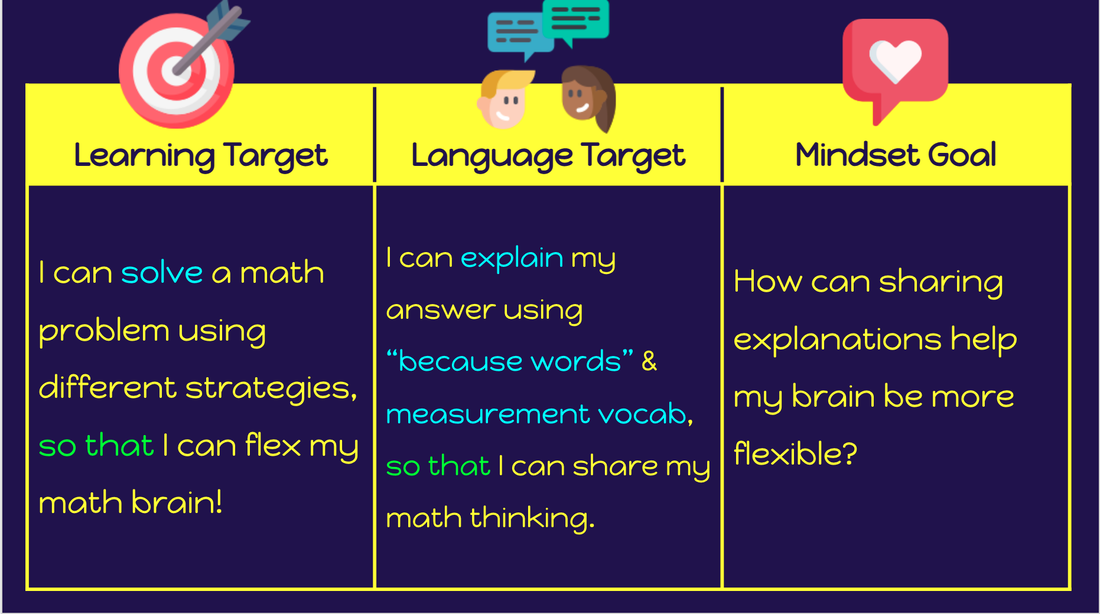
 A split screen of the different targets and competencies we were exploring during a Grade 1 math block. Sometimes written in "I can" statements, sometimes written as a question. 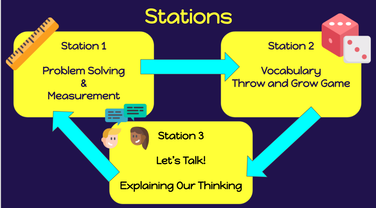 An organizational slide for the students of a math lesson that utilized the station co-teaching model. An organizational slide for the students of a math lesson that utilized the station co-teaching model. In my last blogpost, I shared my emotionally not so unique early relationship with math and teaching. To pick up where the story left off, I had just moved to my new school. I was back in elementary and had 9 co-teachers. During this time my division was going through a math curriculum review. As a school, we were reexamining the "how" we did math, inspired by a new curriculum and Jo Boaler's work. I could get behind the shift to a more conceptual approach. However, to be honest, as much as I was a cheerleader for my colleagues, I opted out of any extra math professional development. I had specialized, it wasn't my wheelhouse. I was responsible for teaching the language of mathematics. That was content and language integrated learning and co-teaching was all about. And then a funny thing happened. As my co-teachers worked to shift their math practice to a more conceptual approach that emphasized number sense, flexibility, thinking, and justification- the opportunities for authentic language in math increased. Students needed to be able to problem solve and share their thinking. In co-planning, we started designing lessons that utilized parallel or station teaching models. Students rotated through stations of number talks, mathmatical games, and language learning. Students were working with claims, sharing during number talks, defending their strategies, and analyzing peers work for misconceptions and miscalculations. There was so much language to be used while we were meaning making. Students' language learning was in service of the discourse to express their mathmatical thinking. 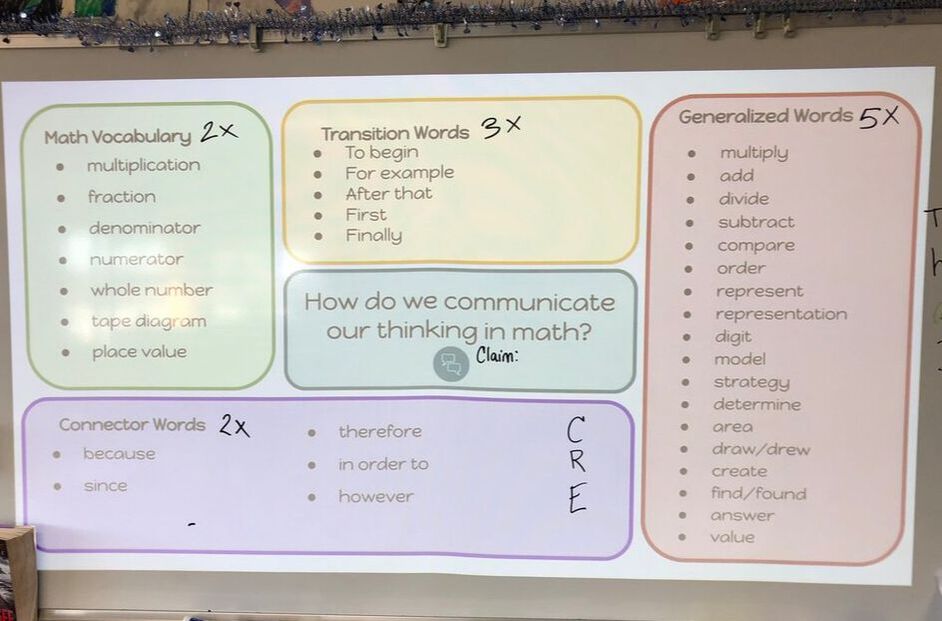 A language anchor chart that I co-constructed with my 5th graders. These are the words that we know we might need to use to describe how we solved a math problem and justify our process. A language anchor chart that I co-constructed with my 5th graders. These are the words that we know we might need to use to describe how we solved a math problem and justify our process. As the MLL specialist in the classroom, my collaboration and teaching during math was no longer limited to simply helping multilingual students read word problems. My instruction was no longer limited to an occasional vocab lesson. For my co-teachers this was not only an instructional shift in their mathmatical practice, but in their understanding of what true collaborative content area literacy could be. From a deficit, medical model of support ("they need help reading the math problems") to an ecological approach to authentic language development alongside content ("how do we communicate our thinking in math?")
Personally, I had unlocked a love for math that I didn't know existed. Mathmatical language became authentic. Co-planning and co-designing for a math block became strategic. Co-teaching during math became joyful. I'll share my favorite discourse and vocabulary driven strategies in Part 3.
0 Comments
|